
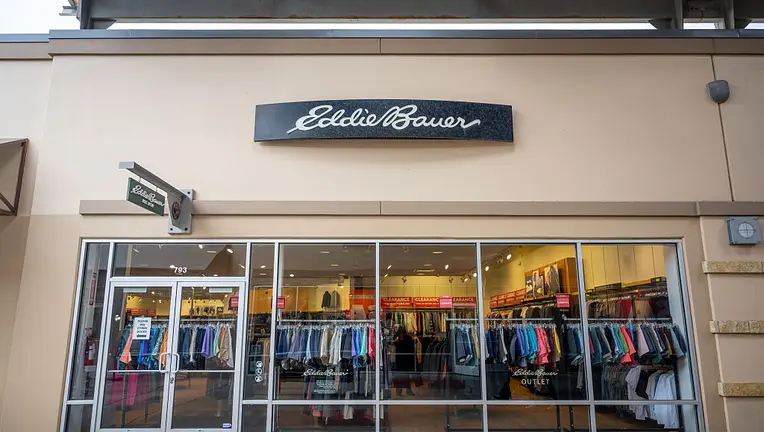
The retail marketplace has no room for nostalgia. Indeed, a brand’s long history doesn’t guarantee survival past 2026. This harsh truth now faces Eddie Bauer, the iconic outdoor apparel company. The brand is preparing to file for Chapter 11 bankruptcy for the third time. Moreover, it plans to close all 200+ of its North American retail stores.
According to a January 29 report from Women’s Wear Daily (WWD), Eddie Bauer will exit the U.S. retail market entirely. That said, its stores in Japan will remain open. Meanwhile, its physical presence across the U.S. and Canada appears to be coming to an end.
This marks the latest stage in a long decline. Originally, Eddie Bauer first filed for bankruptcy in 2003 under parent company Spiegel Inc. After restructuring, it emerged in 2005 as a standalone business. Then, in 2009, it filed again due to heavy debt and falling sales during the recession. At that time, private equity firm Golden Gate Capital bought it for $286 million. Now, over 15 years later, its retail future looks increasingly uncertain.
The fall is especially striking given Eddie Bauer’s legacy. Founded in 1920, the company invented the down jacket. It also outfitted mountaineers, explorers, and even astronauts. Yet today, experts agree the brand has lost its way.
For example, GlobalData’s Neil Saunders recently visited several Eddie Bauer stores. He found them cluttered, hard to navigate, and lacking inspiration. “There’s very little storytelling,” he wrote on RetailWire. Furthermore, he noted that this approach fails in a competitive outdoor market full of strong players like Fjällräven and Arc’teryx.
Ownership changes have also played a key role. Currently, Eddie Bauer belongs to Catalyst Brands, a portfolio formed in 2025 by Simon Property Group, Brookfield Corp., Authentic Brands Group, and Shein. This group also includes Aeropostale, Brooks Brothers, JCPenney, and others.
In fact, RetailWire contributor Craig Sundstrom argues that being part of such a conglomerate makes brands “expendable.” He compared Eddie Bauer’s fate to Lord & Taylor, which faded after corporate reshuffling. Likewise, legacy alone no longer shields a brand from strategic cuts.
Importantly, the Eddie Bauer name may not disappear completely. According to WWD, its manufacturing, e-commerce, and wholesale operations in North America will continue. These units are currently transitioning to a new licensee outside Catalyst Brands. Therefore, the brand could still live on through online channels or department store partnerships.
Still, closing all physical stores would mark the end of an era. For generations, Eddie Bauer represented trusted gear for camping, hiking, and winter adventures. Its disappearance from malls reflects a broader shift: heritage alone isn’t enough. Today’s consumers demand clarity, curation, and emotional connection.
As Sears and Kmart fade into memory, Eddie Bauer may soon join them—not because it lacked history, but because it failed to evolve. Ultimately, in modern retail, relevance matters far more than legacy. And without a clear identity or compelling experience, even century-old brands can vanish overnight.
READ: The New Consumer: How Retail, Hospitality & E-Commerce Are Adapting in 2026


