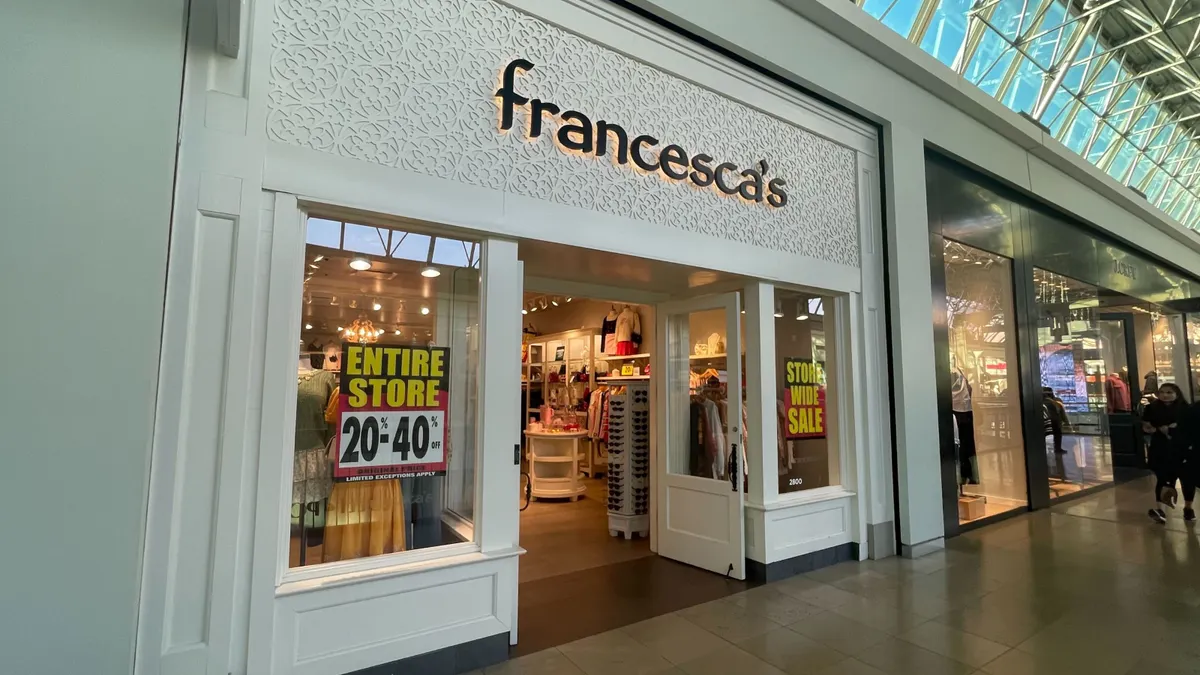
Francesca’s, the popular women’s fashion retailer, has filed for Chapter 11 bankruptcy protection for the second time in less than six years. The filing, made on February 8, 2026, in the U.S. Bankruptcy Court for the District of New Jersey, marks a significant point in the retailer’s ongoing financial troubles. Despite efforts at restructuring and attempts to adapt to a rapidly changing retail landscape, Francesca’s has found itself facing insurmountable financial challenges that have forced it to close stores and enter bankruptcy proceedings once again.
Owned by MAS Acquisition LLC, which acquired Francesca’s in 2024, the retailer is facing a substantial debt load. According to the court filing, Francesca’s has secured debt totaling $30.1 million, and its total assets range between $10 million and $50 million. The company also lists between 1,000 and 5,000 creditors. With this latest filing, the retail chain hopes to restructure and regain some stability, but the road ahead is uncertain.
Financial Troubles and Store Closures
The primary reason for the company’s financial woes stems from a combination of factors, including issues with liquidity following its earlier restructuring attempts. Additionally, Francesca’s has struggled with the increasing dominance of e-commerce, which has eaten into the company’s traditional brick-and-mortar sales. The shift in consumer spending patterns, which has been exacerbated by the growing trend of online shopping, has created a hostile environment for many traditional retailers, including Francesca’s.
The company’s financial struggles were further compounded by underperforming investments in non-core brands like Franki and Richer Poorer. These brands, which Francesca’s hoped would diversify its portfolio, ultimately failed to contribute meaningfully to the company’s bottom line. Additionally, Francesca’s experienced a disruptive data breach in 2023, which caused further damage to its reputation and customer trust.
In its bankruptcy filing, Francesca’s acknowledged the severe pressure that shifting market conditions and macroeconomic factors, including inflation and supply chain disruptions, had on the company’s financial performance. As of 2025, the company reported that only 13% of its sales came from e-commerce, with the majority of its revenue still relying on in-store purchases. This reliance on brick-and-mortar operations in an increasingly digital retail world has left Francesca’s vulnerable to the changing dynamics of the retail sector.
The Rise and Fall of Francesca’s Retail Empire
Francesca’s once enjoyed a period of success during the peak of its operations in 2016 and 2017. At its height, the company operated around 700 stores, with sales exceeding $500 million. However, the company’s growth trajectory began to plateau, and it struggled to adapt to the challenges posed by the evolving retail environment.
The company’s decline was further compounded by a series of ownership changes. In 2020, Francesca’s entered bankruptcy proceedings for the first time. TerraMar Capital and Tiger Capital acquired the retailer during this period, and it was later purchased by MAS Acquisition LLC in 2024. Despite the change in ownership, Francesca’s was still unable to recover fully. The company faced persistent issues with supply chain disruptions, which limited its ability to access merchandise and keep its stores stocked with popular products.
In his court filings, Francesca’s Chief Financial Officer, Curt Kroll, outlined several challenges that contributed to the company’s continued struggles. These included ongoing supply chain bottlenecks, increased costs for goods and services due to inflation, and the broader economic shifts that impacted the retail industry as a whole. These challenges, combined with a shift towards online shopping, led to the company’s inability to meet its financial goals and ultimately forced it to file for bankruptcy again.
Liquidation Sales and Employee Retention
As part of the bankruptcy proceedings, Francesca’s has begun a phased liquidation of its store inventory. The retailer is holding clearance sales at its approximately 400 leased stores, offering discounts of 25% to 40% off across all product categories. New merchandise is also being brought into the stores to facilitate the closing sales, as the company looks to clear its remaining inventory.
Francesca’s has stated that retaining its employees is crucial to the success of the liquidation process. The company employs about 3,000 people, the majority of whom are hourly workers. The retailer is requesting approval from the court to continue paying certain prepetition taxes and fees, as well as wages, salaries, and compensation for its employees. The company emphasized that store employees are critical to ensuring an orderly closure and wind-down process, which will require their expertise in managing the liquidation sales.
Several of Francesca’s key creditors are listed in the bankruptcy filing, including former CEO Andrew Clarke, who served as the company’s CEO from 2020 to mid-2025. Clarke is among the top 30 unsecured creditors. Other significant unsecured creditors include inventory suppliers and major landlords, such as Simon Property Group and Tanger Properties, which own the properties where Francesca’s stores are located.
The Road Ahead for Francesca’s
The future of Francesca’s remains uncertain as the company works through its bankruptcy proceedings. The filing represents the culmination of several years of financial instability and a series of unsuccessful attempts to reverse the retailer’s decline. While the bankruptcy process will allow Francesca’s to restructure and attempt to regain financial footing, the company’s long-term prospects are far from guaranteed.
The key to Francesca’s survival will likely depend on how successfully it can pivot towards a more digital-first business model. With e-commerce becoming an increasingly dominant force in the retail industry, Francesca’s must find ways to integrate online and offline sales channels more effectively if it hopes to remain relevant in a competitive marketplace. It will also need to address the operational and financial inefficiencies that have plagued the company in recent years.
As the company moves through its bankruptcy process, it will need to prove that it can overcome its past challenges and find a path forward. Whether Francesca’s can emerge from this bankruptcy stronger and more competitive remains to be seen, but for now, the retailer’s future hangs in the balance.