In the field of plant and equipment management, the principle that “prevention is better than cure” has long been the cornerstone of operational success. This approach is particularly crucial for complex machines and systems whose continuous operation is essential to support production and ensure the smooth functioning of key processes, especially in industries like food retail where equipment failures can have substantial consequences.
The cost of unplanned downtime can far outweigh the investment in a robust maintenance and prevention strategy. This shift towards proactive strategies has been a fundamental change in recent decades, as traditional mechanical maintenance and service contracts have gradually evolved to incorporate more sophisticated systems.
The Evolution from Preventive to Predictive Maintenance
Historically, companies relied on mechanical maintenance supported by service-level agreements and warranty extensions to reduce downtime. However, as technology advanced, electronic controls were introduced, initially locally, and eventually evolving to remote and integrated systems driven by real-time data. This progression has paved the way for a more proactive and predictive approach to equipment management.
The modern approach begins by analyzing the behavior of individual equipment components and extends to the entire ecosystem of equipment within a facility. The ultimate goal is to not only optimize functionality but also to improve energy efficiency—particularly critical in food retail environments where HVAC/R systems (Heating, Ventilation, Air Conditioning, and Refrigeration) play a key role in maintaining product quality and providing a comfortable atmosphere for both customers and staff.
Servitisation and the Impact of Data-Driven Maintenance
Initially, servitisation in the HVAC/R sector involved selling spare parts and offering preventive maintenance contracts. These strategies were effective in reducing downtime and maintaining operational efficiency. However, as data availability increased with the advent of connected equipment, a technological leap occurred, transforming the field of predictive maintenance.
Through the integration of machine learning, algorithms, and artificial intelligence (AI), predictive maintenance is now revolutionizing the way HVAC/R systems are managed. These modern technologies collect and analyze vast amounts of data in real time, enabling early detection of faults—often before they manifest physically. This evolution allows businesses to address issues proactively, ensuring smoother operations and reducing the need for expensive emergency interventions.
The CAREL RED Optimise Platform: A Case Study in Predictive Maintenance
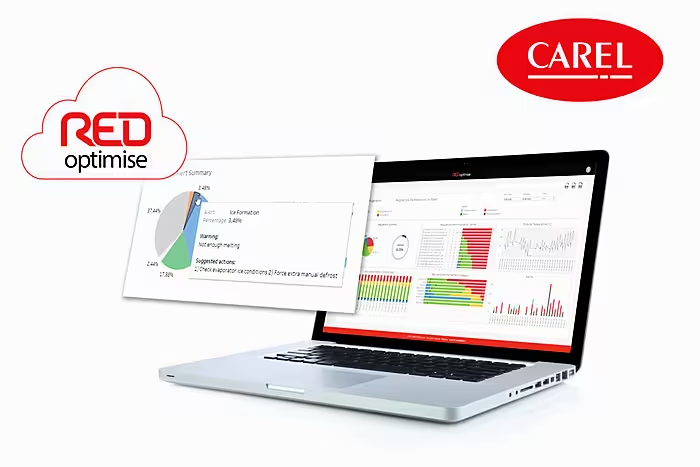
A concrete example of this shift can be seen in the work of CAREL, a leader in the field. Through its RED Optimise platform, CAREL has developed a dedicated tool that prevents HVAC/R equipment performance degradation. One key feature of the platform is its ability to automatically detect anomalies in critical processes such as defrost cycles in refrigerated display cases.
These defrost cycles are essential for ensuring the proper efficiency of refrigerated systems, and when they malfunction, it can lead to performance degradation. The RED Optimise platform detects emerging issues like ice formation and provides real-time technical guidance for immediate resolution. This proactive approach simplifies the work of field technicians and accelerates problem-solving, ultimately increasing system efficiency.
Moreover, the platform uses intelligence and algorithms without the need for additional probes, which reduces the complexity and cost of implementing predictive maintenance solutions.
The Future of HVAC/R Systems in Food Retail
The impact of predictive maintenance on the food retail sector is profound. By shifting from reactive to proactive management, retailers, contractors, and service companies are equipped with advanced tools to optimize their HVAC/R systems. This not only leads to greater operational efficiency but also supports sustainability efforts by reducing energy waste and minimizing equipment failure.
In the fast-paced world of food retail, where maintaining product integrity and a pleasant shopping environment are paramount, predictive maintenance represents a significant step towards creating a more competitive and sustainable industry. By embracing these innovative technologies, businesses can drastically reduce unexpected failures, extend the lifespan of their equipment, and provide better service to their customers.